What Makes a Mobile Drinking Water Machine Different
The difference lies in deployability. Conventional drinking water projects require years of planning, laying of pipelines, construction of pump stations and training of local personnel. That is valuable infrastructure, but it does not help on the day a community loses its water source or a refugee camp is set up from scratch. A mobile drinking water machine can be operational within a few hours of arriving on site. It operates independently of the electricity grid, can be powered by a diesel generator or solar panels and draws usable drinking water from sources that would otherwise be completely unsuitable. River water, groundwater, brackish water and, in certain configurations, even seawater are converted by our systems into water that meets the international standards for drinking water quality.
The Systems We Supply
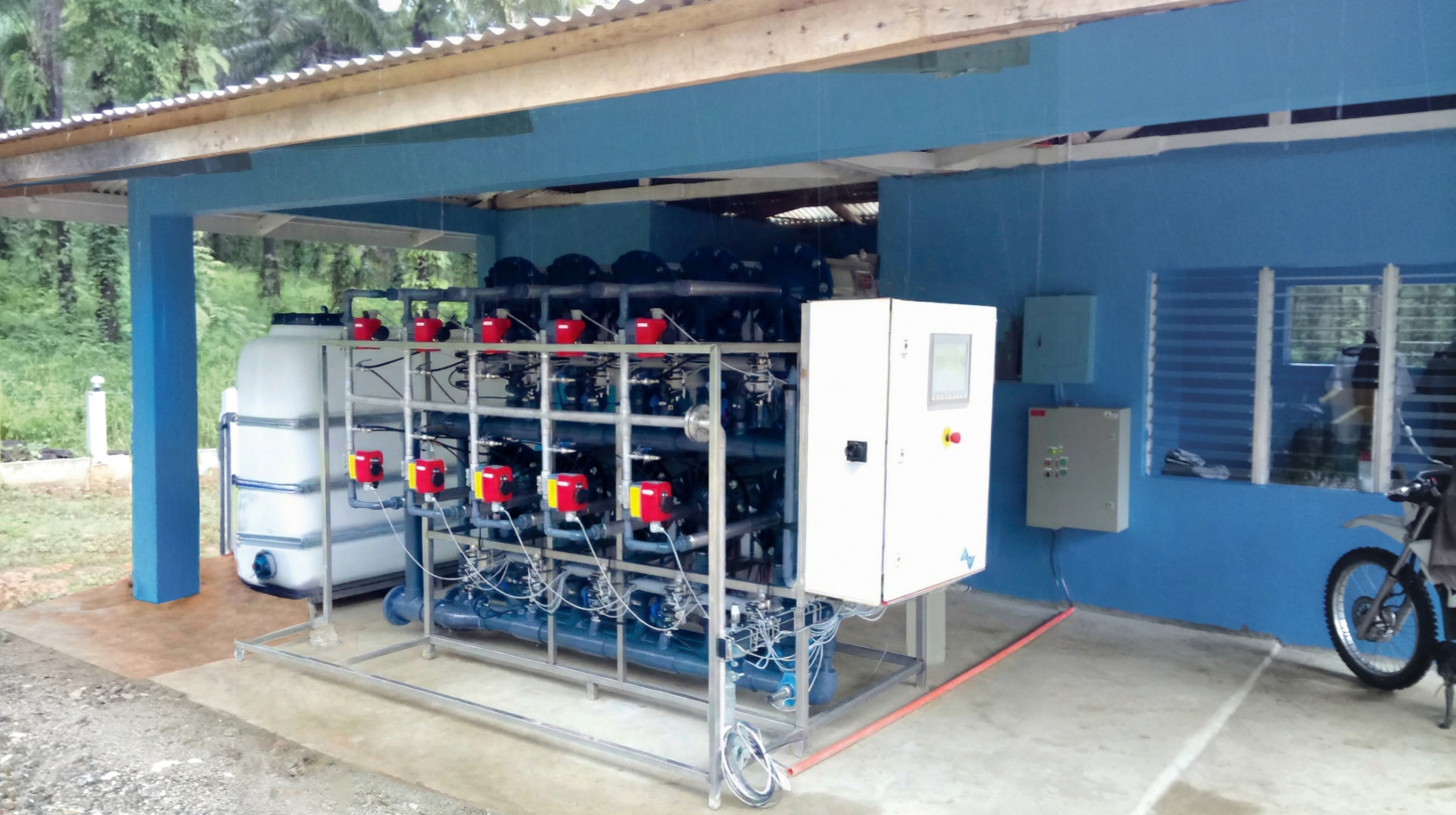
Our smallest systems are designed with speed as the starting point. They are compact enough to be loaded into a helicopter or onto an off-road vehicle and are built to withstand the harsh conditions that come with humanitarian operations. A trained team can have one of these units operational in under two hours. The capacity ranges from five hundred to five thousand litres of drinking water per hour, which is more than sufficient for a community of several thousand people. The filtration in these units works in multiple stages. First, coarse particles such as sand and silt are removed, after which active carbon filters, ultrafiltration and UV disinfection ensure that chemical contaminants, bacteria, viruses and parasites are eliminated. The result is water that is safe to drink, to cook with and to use for basic hygiene.
Container-Based Drinking Water Stations
For larger communities and for situations where deployment needs to last longer, we supply complete drinking water stations in shipping containers that contain everything required for a full water production facility. These units are designed as plug-and-play systems, meaning they are delivered to the site, connected to a water and energy source and are then operational. The capacity is significantly higher than the field units, making them suitable for a small town or a large refugee camp.
Mobile Desalination Units
In coastal areas, on islands and across large parts of the Middle East and North Africa, fresh groundwater is simply not available. The only realistic water source is seawater or heavily brackish groundwater. For those situations we have developed mobile desalination units that use reverse osmosis to extract salt from the water. The membranes that do this work are sensitive to contamination, which is why thorough pre-filtration is essential. Our self-cleaning 3 micron filters deliver significantly cleaner feed water to the RO filter, making the process more efficient and the service life of the system more manageable.
How the Purification Process Works
The purification process in our systems is built as a chain where each step builds on the previous one. We always start with pre-filtration, because no matter how contaminated the raw water is, the finer purification steps can only work properly once the coarser material has been removed. Combinations of active carbon filtration and ultrafiltration are applied to remove bacterial contamination.
Who Uses Our Systems
The applications are wide-ranging, including aid organisations, but there are also applications that are less dramatic but no less important, such as construction projects for communities waiting for a connection to a national water network — something that can sometimes take years.
Simplicity as a Design Principle
One thing that distinguishes us from other suppliers is that we treat simplicity — based on a self-cleaning filter — as a serious design principle. A system that only works when a highly trained technician is present has limited value in an environment where that kind of expertise is not available. Our systems are built so that local personnel can operate, clean and maintain them independently after a basic training of one or two days. Operation is intuitive, the parts that experience wear are easy to replace and the systems give clear alerts when something needs attention. We also offer on-site training and in projects involving long-term deployment in developing countries we actively work on knowledge transfer so that the local community can ultimately look after the system independently.
Collaboration and Delivery
When you contact us we will discuss together which system best suits your situation and your water source, because every location is different and the right configuration depends on the quality of the source water, the required capacity, the available energy sources and the duration of the deployment. Our team of water treatment specialists is ready to advise you on this.
If you are working on a project where drinking water is a challenge, please get in touch. We are happy to think through a solution with you that actually works.